
What the X10 Actually Covers: An Honest Breakdown for Serious Users
Analog versus digital. Gen 2 versus Gen 3. Tube specs, signal-to-noise ratios, forum debates. Strip the noise away and look at what serious users actually do at night—and the X10 handles 99% of it without compromise.
The night vision market is designed to confuse buyers. Analog versus digital. Generation 2 versus Generation 3. Tubes rated by figure of merit. Signal-to-noise ratios. Hundreds of forum threads debating edge cases that almost no one ever encounters in real operations.
Here is a simpler way to think about it: what scenarios are serious users actually in, and what does each one require?
When you go through that exercise honestly, the ASTRA-X10 covers 99% of the situations real operators face. This article explains why—and names the 1% where analog still has the edge, so you can decide for yourself whether that edge applies to your work.
Outside at Night: There Is Always Some Light
The most common concern from first-time buyers is: "what if it's really dark?" The implicit fear is standing in a field on a moonless night and seeing nothing.
Here is what actually happens outside at night, even with no moon:
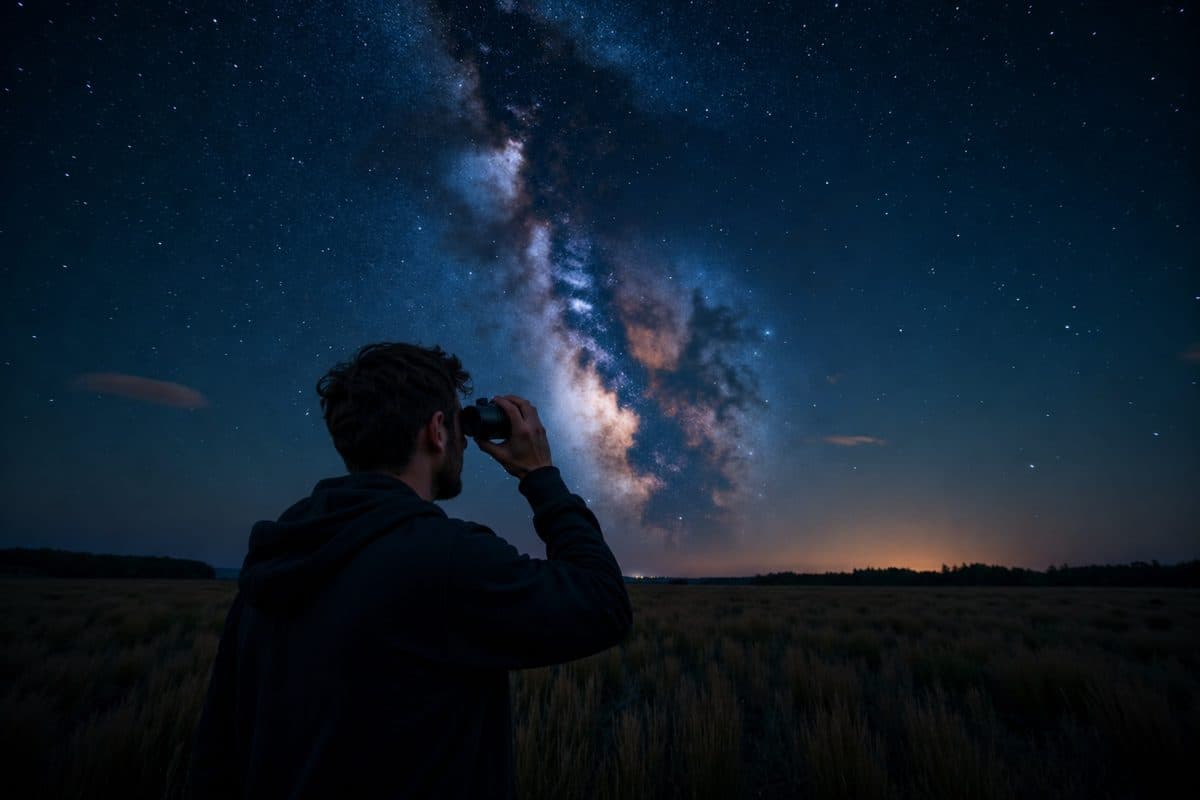
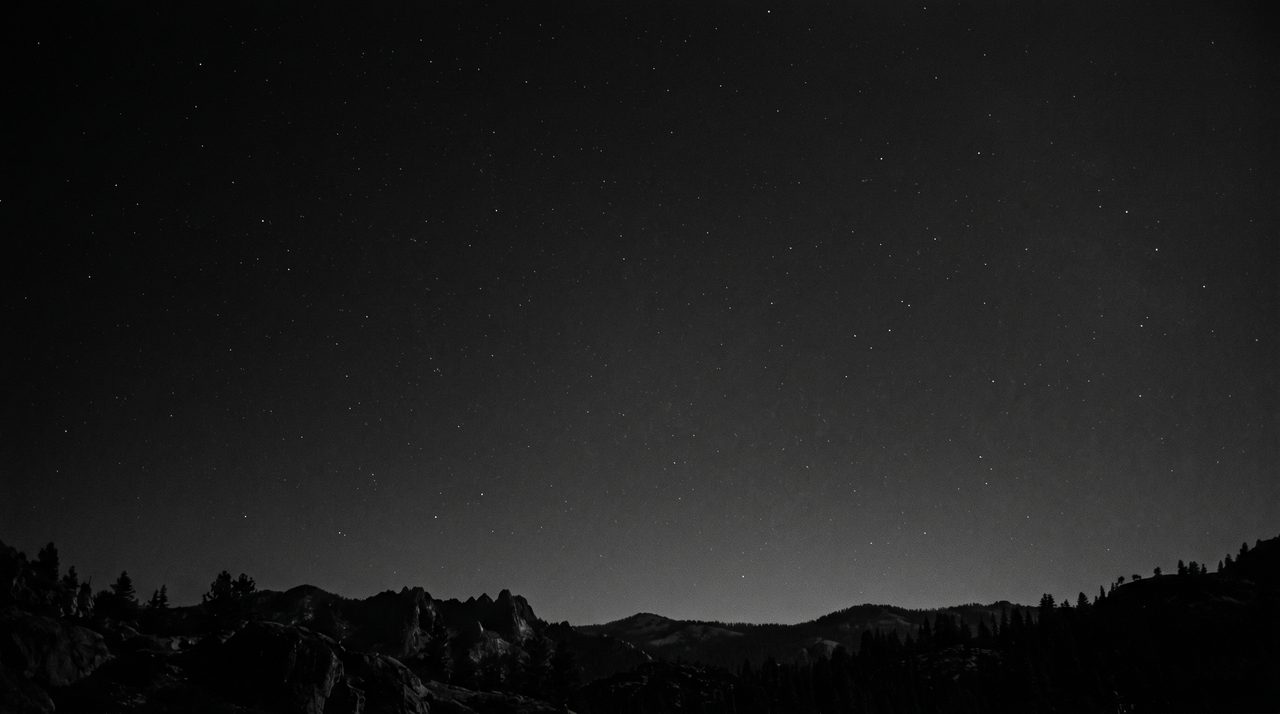
- Starlight. On a clear night, the Milky Way and thousands of visible stars produce measurable ambient illumination—typically 0.001 to 0.0001 Lux at ground level.
- Skyglow. Even in rural areas, atmospheric scattering of distant artificial light adds a baseline level of illumination that is invisible to the naked eye but real.
- Thermal emission. Vegetation, soil, and structures radiate in the near-infrared range continuously. A sensor covering 400–1100nm picks this up in ways the human eye cannot.
The ASTRA-X10 has a minimum illumination threshold of 0.00005 Lux—that is 20 times lower than the ambient illumination of a typical starlit night. In practice, this means that outdoors, in any open environment, the X10 produces a usable image without any supplemental illumination. Forests, fields, trails, coastlines, open water—if there is sky above you, the X10 can see.
You do not need to do anything special. You do not need to switch modes or enable IR. You point it and you see.
Truly Dark Indoors: The Built-In IR Changes Everything
The one environment where passive starlight is genuinely unavailable is inside a sealed structure—a building with no windows, a basement, a confined space. In those conditions, there really are close to zero ambient photons.
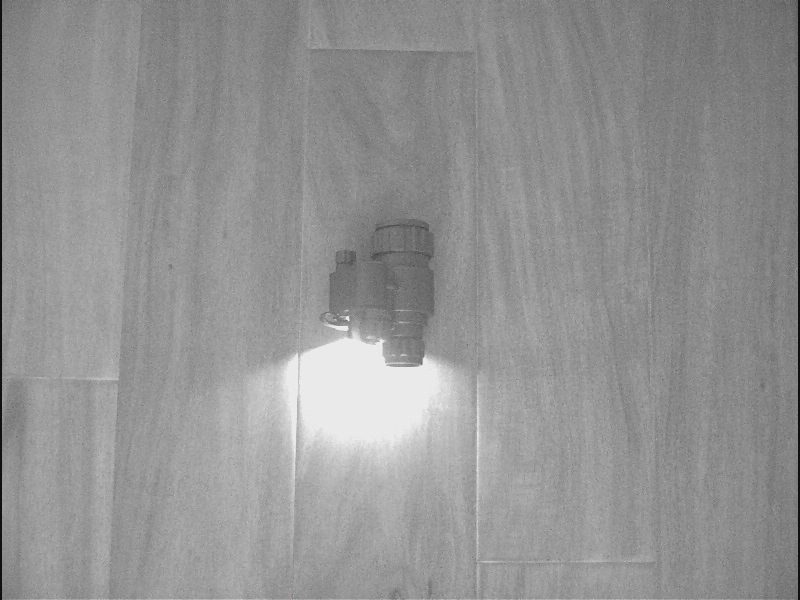
The X10 has a built-in IR illuminator for exactly this scenario. Turn it on and you are projecting near-infrared light—invisible to the naked eye, but bright to the sensor—that illuminates the space in front of you.
What surprises most new users is how little IR is needed. Even at the lowest IR setting, Level 1, the difference in image clarity is dramatic. A scene that looks noisy or indistinct in passive mode snaps into sharp focus as soon as the IR illuminator activates. The sensor is so sensitive that Level 1 is genuinely sufficient for most indoor scenarios—you rarely need to go higher.
The progression is roughly:
- No IR: works everywhere outdoors; limited in sealed interiors
- IR Level 1: handles most indoor and enclosed environments; immediate and significant improvement
- IR Level 2–3: deeper penetration for larger spaces or longer distances indoors
The built-in IR is not a workaround or a crutch. It is a genuine capability that covers any scenario where passive light is insufficient—without requiring you to carry or mount a separate illuminator.
The One Scenario Where Analog Still Wins
There is an honest answer to "when is digital not enough?"—and it is narrow.
Analog image intensifier tubes produce images with effectively zero latency because the entire process is optical and analog: photons in, photons out, no digital pipeline. The ASTRA-X10 operates at 100 frames per second with under 10 milliseconds of end-to-end latency. For almost every human activity, that is imperceptible.
The exception is piloting a high-speed aircraft. At the speeds and reaction times involved in fast jet or helicopter nap-of-the-earth operations, even 10ms of latency in visual feedback can affect a pilot's ability to identify and respond to obstacles or threats. Military aviation night vision standards are built around analog IIT for exactly this reason.
If you are not piloting a high-speed aircraft on night operations—and the vast majority of night vision users are not—this limitation does not apply to you. Hunters, hikers, search and rescue teams, law enforcement officers on foot, security operators, outdoor enthusiasts, airsoft players, wildlife observers: none of these use cases approach the reaction-time threshold where 10ms of latency becomes meaningful.
That is the 1%. Everything else is the X10's territory.
Use a Square Screen for a Wider Field of View
One feature that new users often overlook: the X10 outputs a standard digital video signal that you can connect to an external display. If you plug it into a square or 4:3 aspect ratio monitor, you get the full native 800×600 frame from the sensor—which translates to a wider effective field of view than the built-in eyepiece alone.
Widescreen displays crop or letterbox the image. A square screen uses the full sensor output without cropping, giving you more of what the sensor captured. For stationary observation posts, vehicle-mounted setups, or any scenario where you are watching a display rather than wearing the device, this is an easy way to maximize situational awareness without any additional hardware.
The Practical Summary
| Scenario | X10 Performance | Notes |
|---|---|---|
| Outdoor at night, no moon | Full performance, no IR needed | Starlight alone is sufficient |
| Overcast, rural, no artificial light | Full performance, no IR needed | Atmospheric skyglow and thermal emission visible |
| Indoor, sealed environment | Full performance with IR Level 1 | Immediate, significant improvement on IR Level 1 |
| Head-worn, walking or running | Full performance | <10ms latency is imperceptible at these speeds |
| Vehicle operations, driving | Full performance | Latency well within reaction times for ground speed |
| Hunting, wildlife observation | Full performance | Covers detection range up to 935m for human-sized targets |
| High-speed aircraft piloting | Not recommended | The one use case where analog IIT latency advantage matters |
A Note on "What If I Need More"
One of the most common patterns in the night vision community is buyers who purchase a high-end Gen 3 analog tube for a use case that never required it—and then discover they spent three times as much on a device that is more fragile, cannot record, cannot operate in daylight, and requires careful handling to avoid permanent damage.
The X10 is not a compromise. It is the right tool for the overwhelming majority of serious night vision applications. If your work genuinely puts you in the 1%—piloting fast aircraft at night, where the last millisecond of latency matters—then yes, you need analog. For everyone else, the X10 is the serious choice.