
Built for the Field, Built to Last: What Sets Astra Night Vision Apart
The digital night vision market is full of devices assembled from whatever sensors and boards are cheapest that quarter. Astra takes a different approach: source the best available component at every layer of the stack, design around real user feedback, and build something that works as well in year ten as it does on day one.

Most digital night vision devices share a common origin story. A hardware team finds a serviceable CMOS module, pairs it with a commodity display and a low-cost ISP board, wraps it in injection-molded plastic, and ships it. The margins are good. The specs look acceptable on paper. The product works—for a while.
The failures tend to show up later. A connector loosens after a hundred field insertions. The lens coating degrades in UV. A solder joint fails when the device takes a drop it was rated to survive. The sensor that was "good enough" at launch looks dated two years later because the manufacturer stopped updating firmware for it.
These are not manufacturing accidents. They are the predictable result of building to a price point rather than to a standard.
Astra Night Vision was started with a different premise: build a digital night vision device that a professional operator could carry in the field for ten years, trust completely, and never think about replacing—not because they can't afford to, but because they don't need to.
That goal changes every decision in the design process.
Start With the User, Not the Component Catalog
Before a single part is specified, we spend time with the people who will actually use the device: law enforcement officers, search and rescue teams, outdoor professionals, security operators. Not focus groups. Actual field users, in their actual environments, doing their actual jobs.
The questions we ask are not "what features would you like?" They are harder:
- What has failed on equipment you've carried before—and when?
- What does a bad night look like with a device that almost works?
- What do you wish the device understood about how you use it?
- What would make you trust it with your life?
The answers to those questions drive specification decisions that no marketing brief would ever surface. Things like: the button needs to be operable with gloves and in the dark, with no ambiguity about whether it registered. The battery door needs to open and close reliably after ten thousand cycles, not five hundred. The lens cap needs to stay attached when you pull it off in a hurry, not fall into the mud and get lost.
None of these are headline specifications. None of them appear in comparison charts. All of them determine whether the device is actually useful when it matters.
The Sensor: No Compromise at the Foundation
The image sensor is the most consequential component in any night vision device. Its pixel architecture, quantum efficiency, read noise, and thermal stability determine the fundamental ceiling of what the device can do. No amount of ISP processing recovers signal that was never captured.
Most digital night vision products in the sub-$500 category use 1/2.7-inch to 1/3-inch sensors with pixel pitches of 2–4μm, sourced from whoever offers the best price that season. The image quality reflects that choice.
Astra devices are built around large-format BSI CMOS sensors with 18μm pixels. That is not an incremental upgrade over commodity alternatives. An 18μm pixel has approximately 81 times the photon collection area of a 3μm pixel. It accumulates more signal, produces less read noise per unit of light, and handles the photon-starved conditions of real night environments in a way that smaller pixels fundamentally cannot.
The back-side illuminated (BSI) architecture ensures that circuitry and interconnects sit behind the photodiode rather than in front of it, maximizing the fill factor—the percentage of each pixel's area that actually collects light. The spectral response extends from 400nm to 1100nm, covering the full near-infrared band used by IR illuminators and laser designators that standard Gen 3 analog tubes cannot see.
We do not select sensors because they are available. We select them because they are the best sensor for the application, full stop. The cost difference between these sensors and commodity alternatives is real—and it shows in every frame, across every product in the line.
The Lens: Physics Cannot Be Substituted
A fast lens is not a luxury in night vision. It is physics. The amount of light reaching the sensor is proportional to the square of the aperture. An F1.05 lens delivers roughly 3.6 times more light to the sensor than an F2.0 lens. In a scene illuminated at 0.001 Lux, that difference is the boundary between a usable image and noise.
Every Astra objective lens is specified at the fastest aperture achievable in that optical format—sourced from the best optics suppliers available, not whoever is cheapest that quarter. This is not a specification chosen for marketing purposes. It is the result of treating light throughput as a non-negotiable foundation that no amount of downstream processing can compensate for.
Lens coatings receive the same attention. The anti-reflective coatings on Astra optics are selected for durability in field conditions—resistance to UV degradation, cleaning solvent exposure, and the mechanical abrasion that happens when equipment is used by people focused on their mission, not on protecting their gear.
The Electronics: Built for Reliability, Not BOM Cost
Consumer electronics are typically designed to last three to five years. That is the product lifetime that justifies the component grade, the PCB quality, and the thermal management approach at most price points.
We design to a different timeline. Every board in every Astra product is specified for ten-plus years of operational life in field conditions: vibration, temperature cycling across wide thermal ranges, humidity, and the occasional drop that the IP67 rating is meant to handle.
Component selection reflects this. We do not use the cheapest capacitor that meets the nominal spec—we use the grade rated for the operating conditions the device will actually experience. Connectors are rated for insertion cycle counts that exceed any reasonable field lifetime. Solder joints are inspected for quality, not just continuity. The ISP and supporting circuitry are selected for long-term firmware supportability, not just current performance.
The result is a device that does not degrade gracefully. It simply continues to work.
The Body: Every Gram and Every Edge Has a Reason
Enclosure design in night vision is often an afterthought—whatever tooling is cheapest, whatever shape accommodates the internals with minimal engineering effort. The results are the "obese camcorder" form factors that the night vision community has complained about for years: heavy, awkward, poorly balanced, obviously designed by someone who has never worn equipment on their head for six hours.
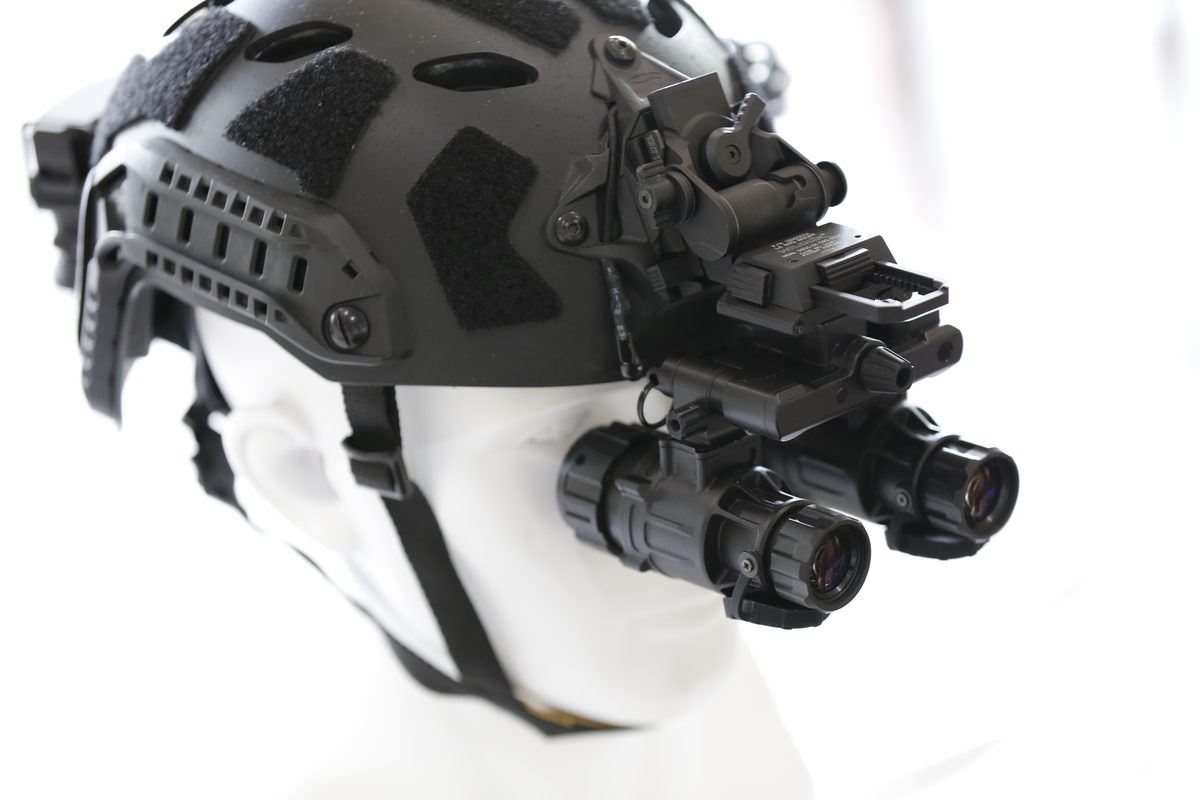
Every Astra enclosure is designed around how the device is actually carried and used. Weight targets are set by what an operator can wear for six hours without neck strain—not by what is easiest to manufacture. Every model is helmet-mountable with standard interfaces. Grip surfaces and button placement are tested with gloves, in the dark, under time pressure, because that is the condition under which the device will actually be operated.
Waterproofing across the product line is rated IP67—submersible to one meter. Not splash-resistant. Not "weather-resistant." Submersible. Field equipment gets wet in ways that marketing copy never anticipates: creek crossings, rain that comes in sideways, condensation during rapid temperature changes. IP67 handles all of it.
Drop ratings are not lab numbers chosen for a spec sheet. They represent the height from which equipment realistically falls when someone trips, sets something down badly, or takes a hit. Designing to survive that impact is a policy decision—one that costs more in materials and assembly but eliminates an entire category of field failures across every product we ship.
The Battery: Standardization Is a Feature
Proprietary battery systems are a recurring frustration in field equipment. They require carrying manufacturer-specific spares, create logistics complexity for teams, and become availability problems when the manufacturer discontinues the form factor.
Astra devices are designed around standard, widely available lithium cell formats—the same chemistry used in thousands of field devices, flashlights, and power banks. Available everywhere. Interchangeable with existing equipment. Replaceable in seconds without tools.
Operating times are specified to outlast most deployments without a swap. When a swap is needed, it takes the same battery the operator already carries for other gear—not a proprietary cell that requires a vendor relationship to source.
This is not a convenience feature. For teams operating in remote environments or extended deployments, standardized power is a logistics requirement. We built to that requirement.
Buttons, Wires, Connectors: The Parts That Actually Fail
In any complex electronic device, the components that fail in field use are rarely the silicon. They are the mechanical interfaces: the button that gets water intrusion after the seal degrades, the wire that fatigues at a stress concentration point, the connector that develops intermittent contact after repeated mating cycles.
These components receive as much engineering attention as the sensor and the optics. Button actuation force and travel distance are specified and tested for gloved operation. Wire routing is designed to avoid stress points at bends and transitions. Connector selection prioritizes rated cycle life and environmental sealing, not just electrical performance.
The supply chain for these components is not optimized for price. It is optimized for the components that will still be working reliably after ten years of field use—because that is the product we are building.
The 10-Year Goal Is a Design Constraint, Not a Marketing Claim
When we say Astra products are designed to function well for more than ten years, we mean it as an engineering requirement applied across the entire product line—not a slogan attached to a single flagship. It changes what components are acceptable in any device we ship. It changes what failure modes are tolerable. It changes what "good enough" means at every stage of development.
A device built to last three years can use components rated for five. A device built to last ten years cannot. The component grades are different, the thermal and mechanical margins are different, and the supply chain relationships that ensure long-term availability of critical parts are different.
It also changes the economics from the operator's perspective. A device that lasts ten years costs less per year than a cheaper one that needs to be replaced every two. And it costs far less than the accumulated cost of replacing devices that fail in the field at inopportune moments—because the real cost of a field failure is never just the replacement unit.
Why This Matters Now
The digital night vision market is growing. More products are entering at lower price points, more operators are being equipped, and the gap between digital and analog performance is narrowing in ways that matter to real users.
In that environment, the differentiator is not who can get the price lowest. It is who can build something that operators actually trust—that performs when it is needed, survives what field equipment survives, and does not require its users to manage its fragility on top of managing their mission.
That is the product Astra is building. Every component, every design decision, every supply chain relationship points toward the same outcome: a night vision device that is genuinely the last one you need to buy.